







Snap the rate con. FleetPath builds the load, plans the truck-legal route, and lines up the invoice.
One system for dispatch, compliance, and settlement, built for owner-operators and fleets instead of a back office you do not have.
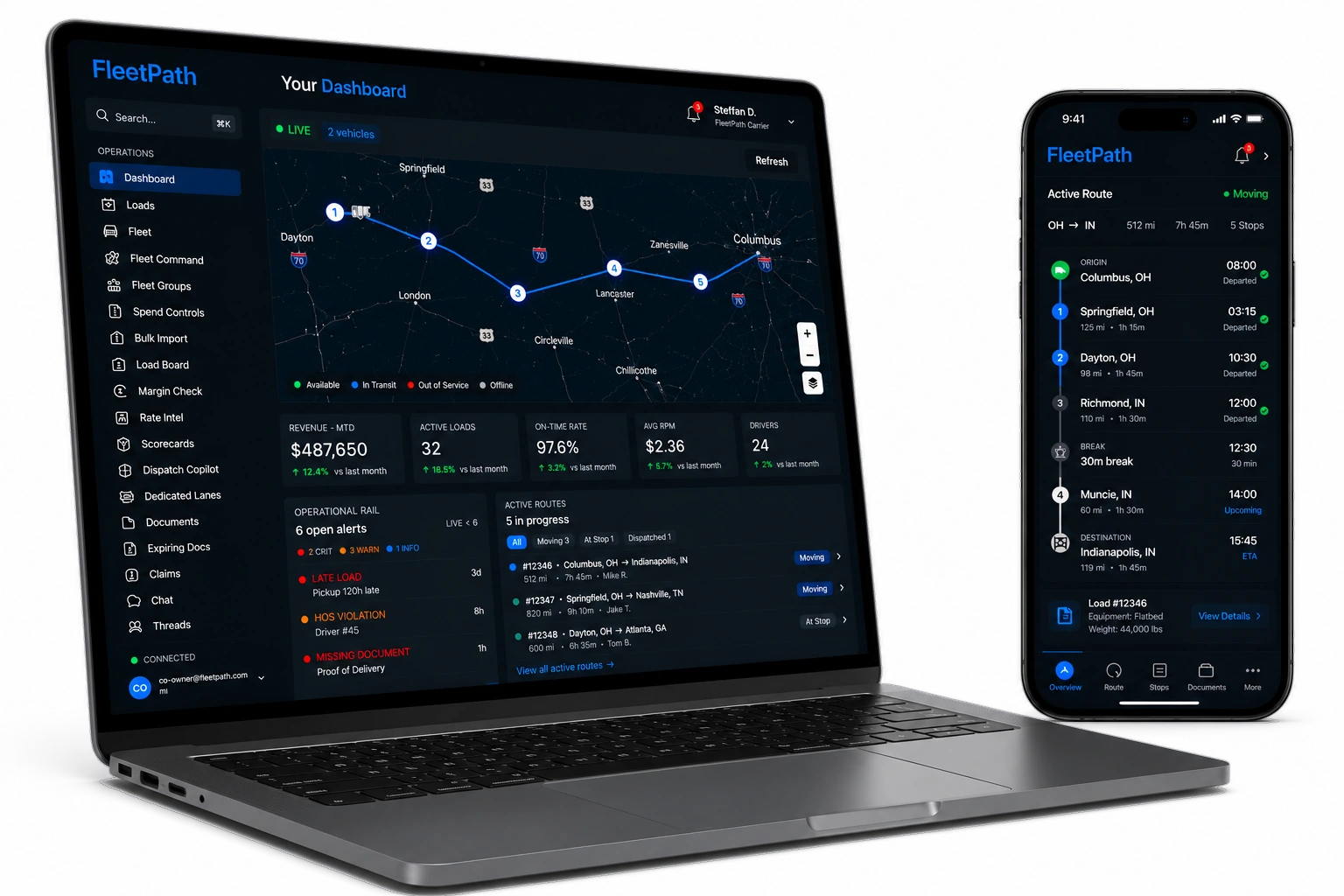
A quick look at the platform your whole operation runs on, from the cab to the back office.
FleetPath takes the paperwork, the math, and the compliance chase off your plate so you can keep the truck moving.
Your papers, your credentials, your pay basis, and your routing rules are different for every kind of hauling. FleetPath knows them. Find your operation.
Permit photo to a compliant dispatch packet, with routing built around your load’s real dimensions.
See howTons in, tickets matched, jobs costed.
See howThe shipping papers, the endorsements, and the route. Checked before the truck rolls.
See howKnow the load before you book it. Keep the truck legal. Get paid clean.
See howProtect the load. Alarm the drift. Prove the cold chain.
See howRun your trucks like the cost center they are, not the brokerage they aren’t.
See howOne vision model reads the actual page, tables, stamps, handwriting, and circled figures included, then files the result to the right load. Production runs on Google Gemini.
The richest read on the platform pulls pay, stops, dates, detention free time, and hazmat or oversize dimensions, then creates the load and starts routing.
Snap the signed paperwork and it attaches to the matching load by reference or PO number, capturing every signature block to close out delivery and start billing.
Reads gallons, price, and whether road tax is baked into the pump price, then feeds your quarterly fuel-tax numbers.
Reads gross, tare, and net, flags overweight, and pushes the actual scaled tonnage onto the load so the job bills real weight, not a guess.
COIs, medical cards, and endorsements are read and expiry-tracked, so a lapsing document warns you before it lapses.
Reads UN number, proper shipping name, hazard class, packing group, and the 24-hour emergency line in regulation order, and flags a paper missing the emergency contact.
The load lifecycle runs as one durable workflow, from the rate con hitting your inbox to the invoice going out, and it picks up where it left off if anything restarts.
Drop in a load-board screenshot and get your real net after fuel, miles, driver pay, factoring, and a detention buffer, the broker’s FMCSA authority and safety pulled live, a suggested counter, and a fuel, toll, permit, and weather risk read. Every dollar is deterministic. The model only reads the picture and phrases the counter.
Each truck gets its top load options ranked by what actually pays you after fuel and deadhead, whether the driver has the hours, and how the broker checks out, with a ready-to-copy counter message. You make the call and you contact the broker yourself.
Routes respect height, width, length, weight, axle count, hazmat class, and tunnel category, then a second pass checks bridge law and clearances. No truck rolls dirty: an expired CDL or medical, a clearinghouse hit, a missing permit, or a failed pre-trip hard-stops dispatch until a dispatcher overrides.
FleetPath watches the clocks, the credentials, and the rulebook itself, and tells the right person before a deadline becomes a violation.
Drive, duty, and cycle clocks come straight off a connected Samsara or Motive ELD, so dispatch knows who has hours before a truck is assigned. FleetPath is not itself an ELD.
Weekly it scans 49 CFR Parts 390 to 399 and recent FMCSA Federal Register notices, and only when the law changes does it draft a plain-English rule proposal for a human to approve. Enforcement is effective-dated, so a rule flips on its own on the date it takes effect.
Every GPS mile is attributed to the state you drove it in, fuel-card gallons roll in, and a per-state return is prepared for your review. Treat the tax figure as a draft estimate, not a filing.
The full pre and post-trip walkaround captures pass, defect, photo, and signature, and if signal drops the whole inspection is queued on the phone and flushes itself later. The driver never retypes a walkaround.
Carrier and broker authority and safety ratings are pulled from the government’s system and re-verified every day, firing an alert the moment authority changes.
DQ files are tracked against all twelve Part 391 items, and when FMCSA schedules an audit, one button assembles the sectioned PDF binder you hand the auditor.
The same engine that prints your broker invoices prints your driver statements, and a machine checks every total before the paper goes out. The AI never touches the numbers.
One live invoice per load so you cannot double-bill, branded with your logo and remit-to, auto-flipping to overdue past terms. The same deterministic engine renders carrier invoices, broker invoices, and driver pay statements.
After a load settles, FleetPath works out true profit: revenue minus fuel, driver pay, tolls, permits, factoring, and breakdown, so you can see which lanes actually make money. Some cost inputs are estimated, so read it as a strong decision aid.
Stuck past your free time, pay a flat five dollars and FleetPath auto-generates the six-document claim packet, demand letter and evidence included. You still bill the broker, but the paperwork is done and provable.
When a broker lands on one of your loads, they pay FleetPath to unlock it. The carrier is never charged for the broker portal.
A broker sees the settlement packet, status, and documents on a load-specific portal. They pay per load or buy a discounted pack. Pricing is $24.99 a load, a 10-pack at $199, a 50-pack at $899, or unlimited at $2,499 a month, all billed to them.
Brokers, shippers, and receivers see the load move on a map, but the position is aged on a hard delay, at least ten minutes for brokers, so nobody can shadow your driver in real time to poach the freight. It is driver safety and lane protection, because that is what it is.
Freight and compliance document types read by photo and validated, with a catch-all reader for the rest.
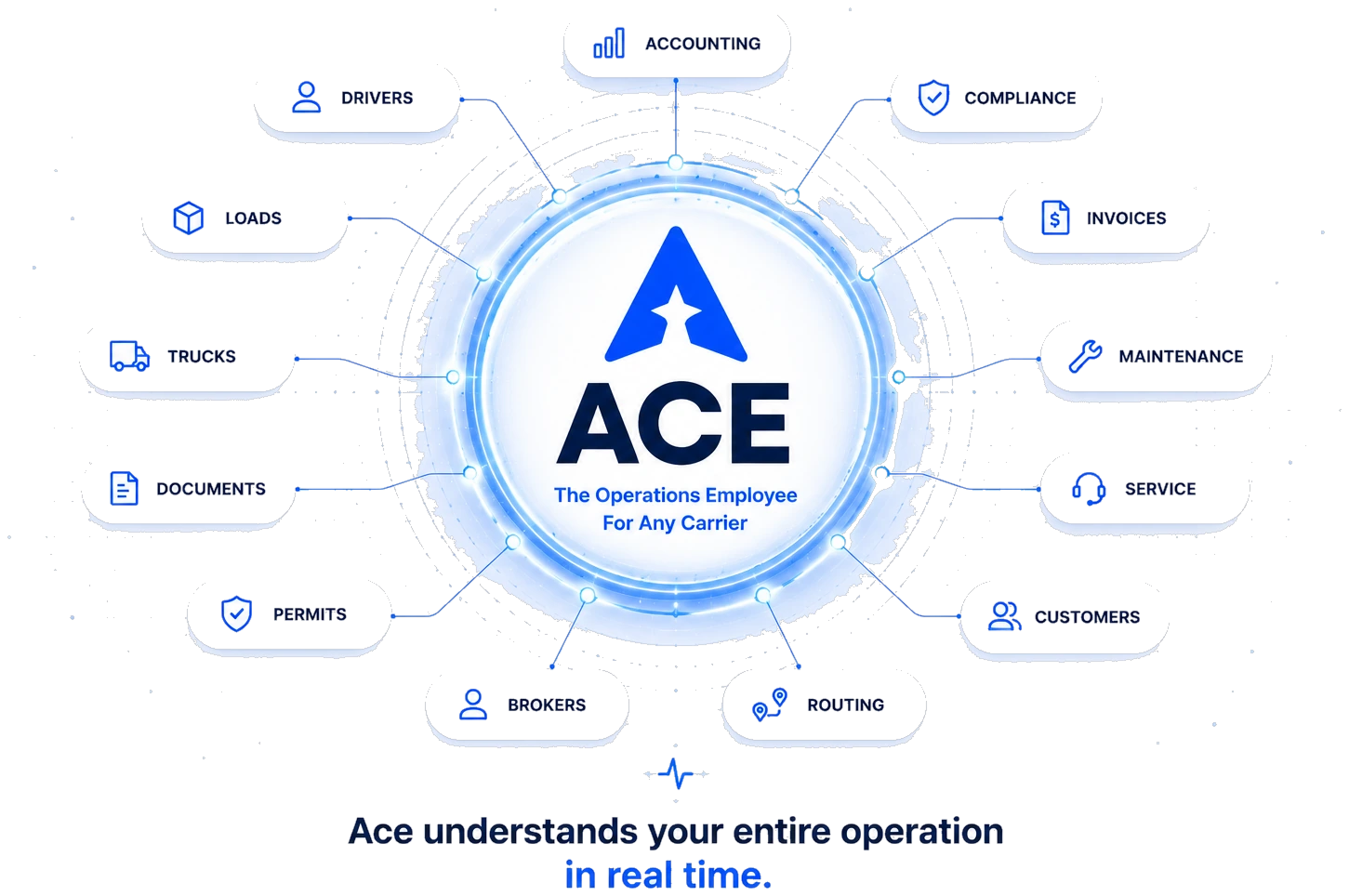
Non-human operator seats you can staff, from dispatch to billing to breakdown recovery, when you turn them on.
The 49 CFR Parts scanned every week for rule changes that affect your fleet.
You pay for iron on the road, not per seat. Park a truck and the bill ticks down.
The carrier back office runs dispatch, loads, fleet, drivers, compliance, permits, invoices, and your own internal load board in one place. Loads at risk, trucks ready to dispatch, documents landing on the right load, money reconciling itself.

The places that usually lie in trucking software are exactly the places FleetPath is strictest.
An operator seat perceives the yard, checks its own budget, then either does the work inside its authority or writes up a proposal and waits. It lives in the same permission matrix and the same audit trail as a human, so it can never reach anything a person in that chair could not. This is in preview, off by default, and every outbound action is gated. Turn it up as it earns your trust.
Set each seat from suggest, to ask first, to act, truck by truck and job by job. The dial can only narrow what a human already allowed, and any glitch drops it back to suggest-only.
A separate deal cap sets the largest booking a seat can make. A load over the cap always routes to a human, and a broker without valid FMCSA authority is blocked before anything binds.
Every turn, proposal, action, and budget stop is a timestamped row stamped as the AI actor, on the same ledger as your people. Full accountability for you, an insurer, or a regulator.
Pause or retire a seat and it stops mid-turn. You are always in control.
You pay for iron on the road, not per login. Park a truck and the bill ticks down. Simple.
Dispatch, compliance, and settlement, from the cab to the back office. Get started and we will get your fleet set up.
Built by FleetPath Technologies, Inc., a wholly-owned subsidiary of publicly-traded Lavish Enterprises, Inc. (OTC: VXIT).